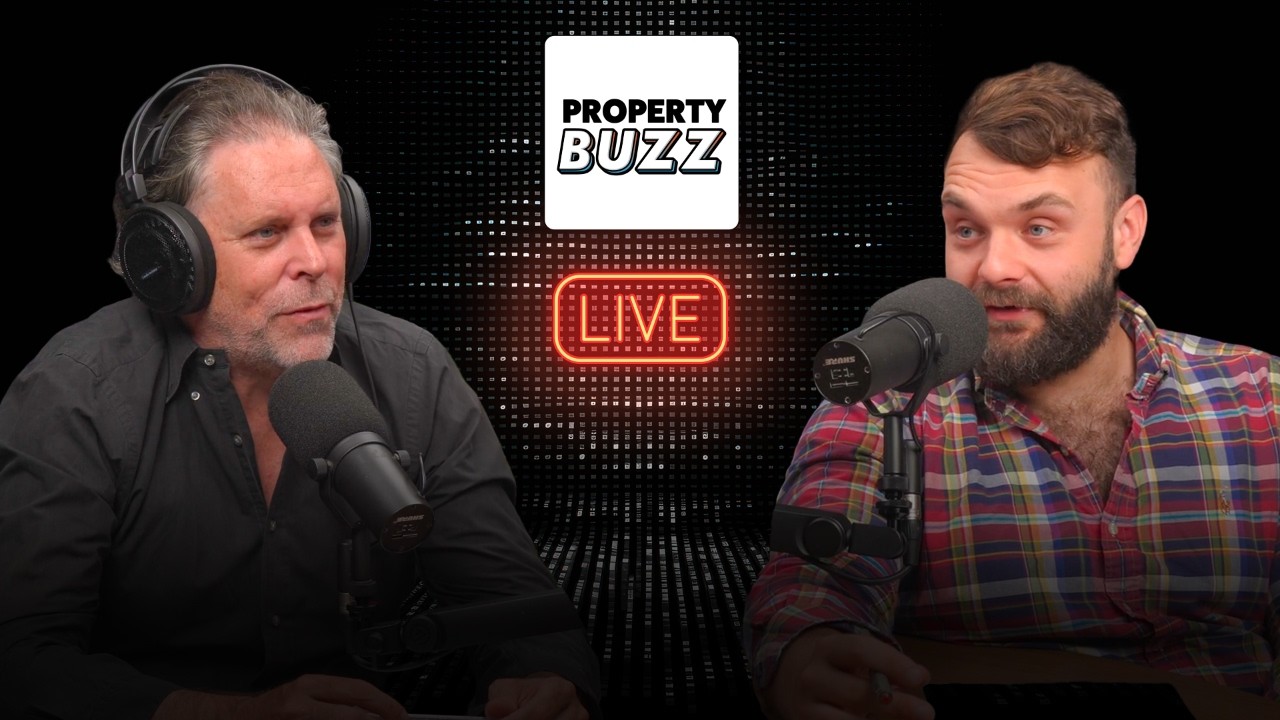
Property-Led Recession? Tom Panos joins Phil Tarrant live to discuss the changing market.
Tom Panos joins Phil Tarrant at the REB Top 100 Agents event to break down where the current correction is biting hardest, by geography and by price point. The pair also discuss housing supply, the budget's impact on investors and SMSF arrangements, and whether Australia is heading towards a property-led recession.
Falling prices, rising rents, and the forces reshaping property Australia’s property market is becoming increasingly divided, with falling prices, rising rents, rate pressures, and government policy creating both challenges and opportunities for investors.
On Property Buzz, Phil Tarrant is joined by Tom Panos to discuss changing market conditions, the mood among Australia’s top agents, and what the shift means for both property professionals and investors.
The pair look at vendor management and the need for agents to be honest about market conditions, from weaker clearance rates and declining prices to the sharp divide between premium and more affordable properties.
The conversation turns to government policy, housing supply, and the broader economy, including the potential impact of higher interest rates and growing pressure on small businesses.
For investors, the picture looks different, with decreasing prices and rising rents creating opportunities for those with the borrowing capacity and cash flow to act, while Panos argues Australia’s underlying appeal remains strong.
Speaker 1: This is a Momentum Media production.
Speaker 2: G'day, how you going, Field Town? Welcome to Property Bars. I'm cheating a little bit. We're not live. You're watching this live on Friday morning, but I'm actually recording it a few days earlier. I've been down here at the Hyatt Regency for the REB Top 100 Agents. I told you I was coming down on Friday morning, so I'm pretty much a week beforehand. But I've actually got a guest in. I thought I'd record live because Tom Panos is joining me. For those of you who know Tom, he's been very active and vocal on social media trying to give some sense to the madness that is property markets right now. What I would say about Tom's commentary and insights is certainly around leadership. It's around sensibility. It's around taking it easy and giving sense for the normalcy of this market despite the fact that many people think it's not normal. We're going to get stuck into it today. I'm going to ask all those questions that everyone wants me to ask questions of. of Tom Panos and let's see what he's got to say for himself. Tom Panos, great to see you.
Speaker 3: Thanks for having me, Field.
Speaker 2: And normally I sort of speak to the camera and speak directly to you now. We've just done RRB top 100 agents, which is the benchmark for excellence in real estate. The best 100 agents in Australia every year are assessed and this is the school card for success. We've just spoken to about 20 or 30 of them face to face. They seem pretty upbeat despite the media telling you the market's tanked.
Speaker 4: What's going on?
Speaker 2: Well, you've got to remember, Phil, the ones that we were speaking to have been impacted, but they're still doing deals because the ones that were here were the better agents. So there's 50,000 or so real estate agents in Australia. REB Top 100's got the pick of the best and what they're doing is moving on it is what it is what I've noticed there's two cohorts of agents in Australia at the moment there are those that are saying what's happened and there are those that are saying it is what it is let's get on with it if you're buying and selling in the same market nothing has changed right and they're moving in and with Phil we accept it I've been involved in seven or eight corrections in my 40 years in real estate. This correction is very easy for a vendor to process because they're on their mobile phone 20 times a day looking at some bad news story. So they're already accepting the reality. So it doesn't surprise me that some of these people here are basically saying, listen, we're probably doing 10, maybe 20 percent lower than before, but they're not doing 50 percent lower. So you're doing the vendor management for Australia's real estate agents. Well, vendor management is telling the truth. I'm telling the truth. Real estate agents may use that. Whether they're using me or they're using the Financial Review, but Phil, I don't like sugarcoating things. I mean, if the clearance rate is 45, there's no need to massage it, manipulate it. Oh look, we saw that two days later, we had this. The bottom line is you can deal with the truth, and quite frankly, the last thing that we need at the moment, where we've got interest rates... question mark on whether they're going to go up again very soon and it does look like there's a chance that we will have a rate rise at some point this year maybe not September rates are tipped at only about a 20% chance going up in September but There's a high probability they're going to go up again because of this inflation. The last thing you want as an industry is to be sending a message out there saying, oh, no, the clearance rate's a lot better than what it is. Now, I'm not quite sure what the Reserve Bank does to make up their decisions each month on what they're going to do. But I can tell you it's not a good story if real estate agents are sort of saying the market's a lot better than it is. These agents that were in this room here today. Today, feel the nature of the truth. We're down to the Zephyr Bar, which is at the top of the Hyatt Regency. The sun's out, it's a Friday afternoon, it's pretty good.
Speaker 5: It's
Speaker 2: it's
Speaker 5: a cracker.
Speaker 2: Really nice looking out over Darling Harbour. You got the Anzac Bridge in the background, Para in the distance. I can see those towers rising there. Bit of a hot bed for investment right now, Paramatta. But if there is a lot of noise in the background, it's because we're right in the middle of one event and we're about to have Australia's best mortgage brokers about to come upstairs for the Australian Broking Awards. I know you do a lot of work. Got to work with brokers as well, Tom. How bad is the market right now?
Speaker 6: Okay, so in a one-minute summary, this is what the market, we've got firstly geography, around Australia, there are different markets because we've got geography, then we've got price points. So you've got to overlay the geography with the price points. At a high level. The most expensive properties in Australia have copped it the most, drops of around 15, maybe 20%. The middle range has dropped it a little bit less. The marketplace at the lower price point has not dropped much at all. In fact. It appears that first home buyer price points are now attracting the remaining investors and people that are being more conservative with their real estate. So you've got this competition at the lower price point. So if you ask me from a geography point of view, Sydney and Melbourne have probably to date had the biggest drops. Brisbane, Perth and Adelaide only started dropping when the budget came into play. Sydney and Melbourne started dropping November when rates started to go up. In terms of price points, as I've said to you, highest is the biggest drop, medium, second biggest drop, lowest price point hasn't really dropped at all too much.
Speaker 2: Okay, so some sense of the market there and it gives you some clarity on where the money is going right now. There's a lot of stimulus in relation to the government budget and a view towards sort of championing first home buyers. We'll get into that in a moment. Tom's come on today as my special co-host for Property Buzz. And as you all know, I don't really let people onto this. We normally keep it pretty protected away from people who might be trying to sell you something. Tom's not trying to sell anything.
Speaker 6: Show
Speaker 2: He doesn't even
Speaker 6: you
Speaker 2: want
Speaker 6: The to truth.
Speaker 2: tell you the truth. He sells you the truth. He tells you the truth. He's only selling stuff on a Saturday. If you ever see him at an auction, he's very good at it. But Tom's stepped in as some series of special guests. I'm bringing in over a period of time with my good friend and associate leading garment out and about doing other stuff. stuff. How bad is this government, Tom?
Speaker 6: Look, when it comes to property, firstly, many people are going to be surprised to know that Tom Panos is not a right wing rage baiter. I've voted for Labor more than I've voted for Liberal. Part of the reason is I was brought up in the Canterbury Bankstown area. I was brainwashed by my parents, migrants that had come to Australia in the 60s, and they said, Gough Whitlam is our man. You're a Labor man, working class party, right? That's how I was brought up. However, I'm not married to political parties. I'm married to common sense. And if you're asking me the question how bad it is, I think they've got a very low rating. It's very poor performance. If you think about what has actually happened since the budget, there's normally when decisions are made, you get one group of people that are happy and one group of people that are very unhappy. What we've got here is most people, nearly all people are unhappy. And how do I know that? I've got people that are renting that stop me all the time that are sending me DMs. First home buyers, you'd think they'd be happy. They're not happy, right? People that own real estate, why? They're not happy because you've just told them the equivalent to your kids ugly. Your house has just dropped 10, 15 percent. No one's happy. I think we could have gone about this in a far better way. And the thing that annoys me the most, Phil. is instead of the opportunity that the government had to show leadership and to create some innovative changes to the tax system, right, all they did is get a monopoly board and try and move things around. At no stage did they actually say, we've got a housing supply issue here. Let's address it. In fact, what's happening post-budget less houses fill. And now with these developers all going. Going belly up. The last one is the one the other day up there in, uh, in the western of Sydney, at 15,000 properties on the go there. All these things here are saying to me we have got a chronic supply issue, and that's why I feel really safe about real estate in Australia.
Speaker 2: And that's why you should stay safe about real estate in Australia. And I've always said, you have some great partners in real estate in Australia: the banks. The banks want to fund it. Banks are in the business of making money through mortgages. Are they going to be putting their money in a safe bed, and that is Australian real estate? Up until this point, the government's backed Australian real estate because they don't want to be landlords themselves. So they've wanted private landlords to actually do
Speaker 6: So
Speaker 2: the heavy lifting.
Speaker 6: let's talk about that for a moment, right? Let's talk about that. Why are we in this situation today? Because many, many years ago, I'm not pointing my finger on elbow. I'm pointing the finger on the governments of Australia many, many years ago. The Australian government decided we're not going to provide public housing. They were doing it. You know what they said? Get the mums and dads to do it. Get them to do it. And you know what? They said, listen, it's expensive. You're going to be losing money. So what we'll do is we'll help you offset some of your losses, which was the negative year. But we did the hard work. Now they've come along.
Speaker 2: And instead of saying thank you, they've said, nah, we actually want a slice of that action. Yeah, and that's the way it is now. And where a lot of the criticism is, not only those people who negative geared, who have that grandfather, but these young, young folk coming in trying to make, make their mark and make a few bucks through real estate, a lot of that's gone. That doesn't set. I've never, I've personally never negatively geared a property in my life. It's never come into my equation because of the structures I invest in. So we need to be conscious that property is an asset class. Class is typically a good asset class if you go about it the right way. Now, this podcast, Property Buzz, we're not scared of being a bit political with it all, and yeah, we'll... We'll tell the truth where the truth needs to be told, Tom. My personal view is that I think a lot of these changes to housing policy will need to be overturned. I've said it on record within 18 months. They're going to have to pull back this SMSF arrangement because there's so many properties getting built out of the ground. And we're looking here in Darling Harbour right now and there's hotels going up. But you look further out west there, there's places going up all over joint. 20 to 30 percent, and 40 percent of those new build properties are underpinned by super fund investments, right? They can't do that no more. There's 15,000 properties not getting built because of this issue that we've had with this developer going bust last week. Mate, I'm really concerned about it. I was actually texting, he's just responding to me, to me there, a pretty well-known Liberal politician. They're fighting the good fight down there because they know what's coming, and my personal view right now is there's Armageddon we're approaching. approaching a property-led recession not only here in New South Wales but Australia-wide and I think a lot of people don't actually know what it's going to mean when we end up in that situation now I might be a merchant of doom or doom day merchant but I don't know any business owner right now Tom who is saying it's a good time to be in business and that concerns me and it worries me a lot Phil
Speaker 6: And what's even more concerning is that some of these great businesses, some of these, let's pick Portelli for a moment, only because he's got a bit of profile, right? Suppose last year he did $30 million in tax, right? He's disappeared, gone off to Dubai or have some sort of relationship with Australia, but the bottom line is he's gone. When we lose people. that own businesses, we also lose the benefit of the tax that these businesses contribute, right? Number one, we lose talent field. We lose great people. They don't just leave themselves. They take their teams with them. They take their staff. So we end up losing a lot of capability. And I did a post up yesterday. The last thing that we've got to be very careful, Phil, and everyone that's should. Listen to this right now should understand the one thing we've got to be very mindful that doesn't get swallowed in the next one or two years is ambition. ambition. Ambition is basically saying, let's get better. Ambition is building. Ambition is growing. Ambition is employing people. Ambition is saying, I'm going to give these 50 people a job while we create this new product that solves a problem. If we start having people have what is called learned helplessness, where they turn around and say, there's no point, we could end up becoming a country. that basically lives in little Lego style units owned by international organizations where people are taught be happy, don't have high hopes, you've got a place to rent. You might not even own a lot of things, Phil. You might not even own a bicycle. You might be using your mobile phone to do a QR code and get on one of those lime bikes. We've got to be very careful that we don't suffocate ambition. Ambition is what built this country. If you look at what happened in the 50s and 60s, people came here because they saw there was ambition, opportunity, build houses. I've come from a Greek background heritage. Greek heritage the Greeks Italians and other migrants came here they were building houses in fact it was known they're building Australia right yeah they're the Greeks and Italians and and and Australians didn't treat them well when they arrived you know and you guys did you did it hard that you guys as in as a cohort this community you did it hard for many many years until Australians actually got the contribution that but feel And it's interesting, we can talk about migration because migration is an important issue as well, right? Like it would, I mean, the issue that we're going at the moment is the speed of houses being built is totally being outpaced by the amount of people that are coming into the country, right? And I get migration, migration is important, but you need to get migrants that are carpenters and electricians and builders.
Speaker 2: The unions don't want to make, they're pushing back that because they're pushing. pushes our labor. Just while we're talking about stifling ambition, Tom, I'm going to put you on the spot here. It's not a deliberate thing, but just you may know this number. What percentage of Australian businesses generate less than a million dollars in revenue? Pop quiz. I was looking this up last night.
Speaker 6: What percentage of Australian businesses generate less than a million?
Speaker 2: Yeah, I want to put things into perspective here.
Speaker 6: Okay, I'm going to have a...
Speaker 2: crack and say 65 okay so under a million dollars in revenue so there's 2.3 or 2.4 million businesses in australia 92 to 93 percent
Speaker 6: Wow.
Speaker 2: Of Australian businesses.
Speaker 6: Wow. I was going to say 50, but I thought to myself, he's asking me a question here. Is it that much? So essentially you're telling me pretty much every business in Australia does under a million dollars.
Speaker 2: People don't understand. You get sold
Speaker 6: So
Speaker 2: on.
Speaker 6: we've got these new laws that are treating the 90% with the other 10%.
Speaker 2: Yeah, so between $2 and $5 million, right, 4. in revenue, 4.7%. five to ten million is 1.7 percent of australian businesses and only 1.9 percent of australian businesses generate more than 10 million dollars of revenue and you talk about ambition people being stifled you know you get sold this message that businesses they're this that and the other and whatnot most australians who run a small business they're micro businesses they're just getting out there battling trying to push ahead like it's a The fraction, if you go, I'll ask how many businesses do more
Speaker 6: So
Speaker 2: than $30
Speaker 6: feel
Speaker 2: million.
Speaker 6: that concerns me because I'm worried that this 90% cohort of businesses all of a sudden are going to start saying maybe the best thing to get ahead in life these days is just go get a job in Canberra and become a public servant.
Speaker 2: Exactly.
Speaker 6: That's what worries
Speaker 2: Well,
Speaker 6: me.
Speaker 2: what worries me, though, is that if most of the money generated in our ecosystem is through Australian business. Business, right? If you look at the numbers, I think the bottom 50 of Australian taxpayers contribute six percent to taxation receipts at a federal level. It's tiny, right? So...
Speaker 6: You
Speaker 2: this
Speaker 6: know I've been knocked off my feet with that stat.
Speaker 2: 0.2 to 0.4 percent of all active australian businesses do more than 30 million dollars in revenue it's a tiny fraction tom So the heartbeat of this nation is Australia's small businesses. They're the people who are hiring people out in the burbs getting it done. They're the people most under stress and threat right now. And these are the people who don't have a lot of faith in committing to growing in Australia because of this tax on aspiration has taken place. It's a big issue. And this goes back to my point. Things happen slowly and then very, very fast. I think Australia is going to have a pretty harsh wake-up call. Not too far away where people actually sit and just go, what just happened? If there's no businesses to tax, how are we going to run the country? There was a beautiful book written many, many years ago, one of the most famous Australian authors. I'm just having a mental blank, but I'm not going to get that, get in the way of the story. They're sitting at a bar and one person says to the other, while they're drinking cognac, how could you go bankrupt?
Speaker 6: And the guy looked at him and he says, slowly, then suddenly. It's concerning, Phil. It is concerning because we've heard one word or one term over and over over the last six months, unintended consequences keeps coming up, coming up. And I've got to tell you, one of the biggest unintended consequences is exactly what we're speaking about right here, Phil.
Speaker 2: Yeah, so I don't want to leave everyone on you know being depressed and concerned and worried It's a great nation to be look where we are right now Now.
Speaker 6: Phil, it's a great, and that's why you're the one that alerted me to this when you said to me about a month ago we were chatting, we were talking about what it costs salary. To buy a home over the years, and I totally accept that the ratio has gone up. It's been highly pushed by Sydney. Many, many years ago, it was like income, five years income to pay a house, right? It's all changed. But you said something very valid. Look at the product. It's a good product. People want to live here. Right. Anything that's good costs more money. You fly business class, you pay more money. You drive a Lamborghini, it costs more, right? Australia is a great product. And that's why people are coming to this country. And we've got to accept things that are good cost more.
Speaker 2: Mm. That's the way it is. Anyway, so what do you do about all this? Well, keep treating the Tom Panels. You can follow him on social media. What are you, more on Facebook, Instagram? It...
Speaker 6: I
Speaker 2: depends
Speaker 6: do all the content I do, I post myself on Instagram. I actually don't have a social media agency.
Speaker 2: Do it yourself is...
Speaker 6: I do it myself.
Speaker 2: That why it's raw and authentic? That's why people like it.
Speaker 6: Oh, well, the other thing is I'm not going to have social media dictate my life. So what you'll notice, Phil, pretty much every bit of my social media content. then is done while I'm doing a second thing. I'm walking, I'm at the gym, I'm at an airport, I will always do it at the same time. I'm not the kind of person that puts in my diary, oh, it's social media time today, right?
Speaker 2: So you're not putting makeup on and making
Speaker 6: No
Speaker 2: sure you
Speaker 6: makeup.
Speaker 2: look good,
Speaker 6: No,
Speaker 2: no.
Speaker 6: and as far as I'm concerned, a lot of the stuff that you put makeup on TV doesn't get the views and engagement of the non-makeup.
Speaker 2: There you go. Um, that's Tom Panos. I might try and bring him back again as a special guest, so he's really touching the surface here. We're getting thrown out of this joint because they're in between a couple of different events, um, so we've got to get kicked along. But this is Property Buzz. It's where we get stuck in the stuff and have those conversations a lot of people are uncomfortable about, not only the direction of Australia, but in particular the property market. So, much like myself, Tom is just having a... Old crack, and he invests in real estate as an asset. It's probably been good to him.
Speaker 6: Phil,
Speaker 2: So we're just hoping.
Speaker 6: I've got to say before we leave, this market is perfect for me. Prices have come down. Rents are going up. I've never been a negative gearer like you. This is happy days. If you're an investor, you're better off buying an investor now. If you're my kind of investor, which is that you weren't the type that had 50 properties on the go relying on their negative gearing. For me now, mate, you're buying good value. You're buying 10, 15% lower. Rents are going up. It's happy days.
Speaker 2: Happy days. It's the days of yield, no doubt, but property markets always bounce back and Tom can come and talk about that again at another point in time. This is Property Buzz.
Speaker 6: Thanks for tuning in. We'll see you again next Friday, same place, same time, and who knows who I'll be with. I'll see you then. Okay, bye.
Speaker 7: The information featured in this podcast is general in nature and does not take into consideration your financial situation or individual needs and should not be relied upon. Before making any investment, insurance, tax, property or financial planning decision, you should consult a licensed professional who can advise whether your decision is appropriate for you. Guests appearing on this podcast may have a commercial relationship with the companies mentioned.